
Search Website
Rotman Graduate Student Conference 2026: Philosophy in the Life Sciences, Life Sciences in Philosophy
Kathar Fedjki, Kardelen Kucuk, Sara Varon Echeverri
The life sciences, including neuroscience, biology, cognitive science, psychology, and ecology, seek to understand living systems by describing how they function, explaining the mechanisms that sustain them, predicting their behaviour, and in many cases intervening in or manipulating these systems for human purposes. Humans occupy an interesting position in all of this: we are the object of study, and yet we are also the researchers. At every stage of this work, various philosophical questions arise: How should we understand mechanisms, causation, or the constraints that shape biological systems? How do the choices of methods and models influence the knowledge that is produced? What forms of integration across the life sciences are possible, if any?
Over the course of the Rotman Graduate Student Conference, held on May 2 and 3, 2026, more than 50 graduate students, professors, and other scholars gathered to bring philosophical reflection to bear on questions like these; clarifying key concepts, examining disciplinary assumptions, and revealing connections across the life sciences.
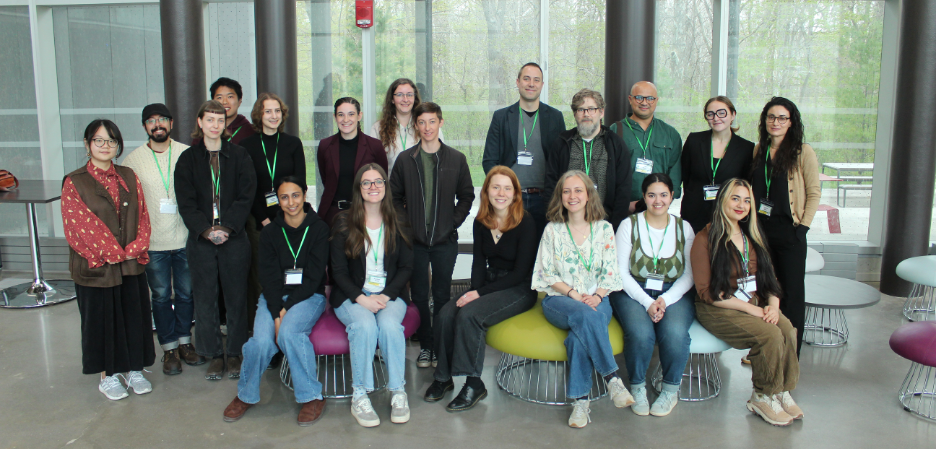
Graduate students and researchers from diverse disciplines and from several universities got together to discuss the philosophical issues in the life sciences.
The conference gave 15 graduate students from universities in Canada, the United States, and Scotland the opportunity to present their work on the philosophical issues of the life sciences and receive feedback from their peers, professors, and researchers across disciplines. From biological agents to bioethical concerns related to patient care, these students presented their research and opened their underlying assumptions to debate, sharpening their arguments in the process. In an interdisciplinary field where different disciplines bring distinct assumptions, methods, and explanatory frameworks, spaces like this shape how researchers communicate, collaborate, and decide which problems are worth pursuing. Philosophical reflection on the social and ethical stakes of this work fosters more self-aware researchers, contributing both to the advancement of knowledge and to more responsible scientific practice. Philosophical reflection on the social and ethical consequences fosters more responsible and self-aware researchers, contributing both to the advancement of knowledge and to ethically informed, socially responsible scientific practice.
The conference was supported by the Rotman Institute of Philosophy, the Canadian Journal of Philosophy, the Western Institute for Neuroscience, the Schulich School of Medicine & Dentistry, the Faculty of Arts and Humanities, Western Research, the Society of Graduate Students, the School of Graduate & Postdoctoral Studies, and additional generous support from some departments at Western University like the Department of Philosophy, the Department of English and Writing Studies, the Department of Biochemistry, the Department of Gender, Sexuality, and Women’s Studies, the Department of Computer Science, the Department of Physics and Astronomy, and the Centre for the Study of Theory and Criticism. This support made it possible to host two keynote speakers: philosopher Dr. Lauren Ross of the University of California, Irvine, and scientist Dr. Dani Bassett of the University of Pennsylvania. Their collaborative work offered a clear example of the productive interplay between philosophy and the life sciences, showing how each can inform and enrich the other.
On May 2, 2026, Dr. Dani Bassett presented “The Humanity of Science”, which discussed how the progress of science on the formal and informal exchange of information between people, and how the systems through which this exchange happens raise social and justice concerns. More specifically, their presentation examined citation practices in several disciplines from 1995 to today and, by doing so, they demonstrated that citation practices differ by author gender, vary with journal prestige, and track social norms of small groups, larger disciplines, and whole countries. These results show that scientific practices are embedded in human behaviour and, therefore, they are also affected by our biases and our preconceptions. This presentation sparked a lively discussion on our capacity (or incapacity) to separate the subject and the object of science.
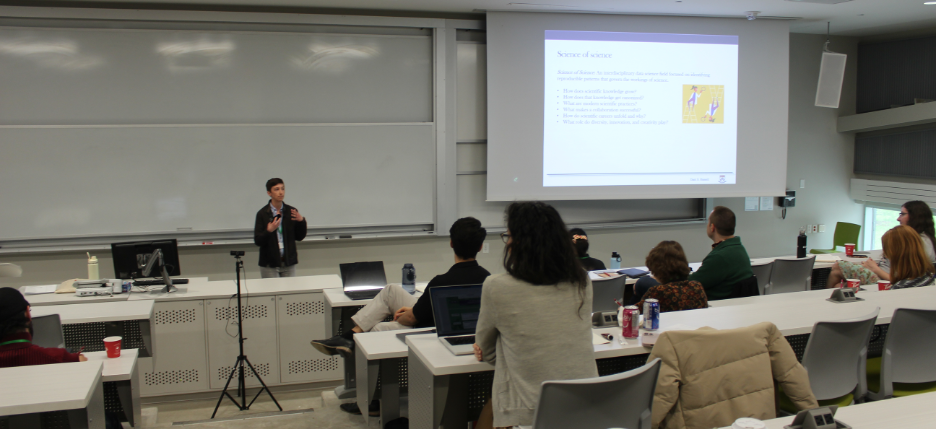
Dr. Dani Bassett, J. Peter Skirkanich Professor at the University of Pennsylvania, delivered a keynote talk at the Rotman Graduate Student Conference 2026.
(Photo: Kardelen Küçük, Western University)
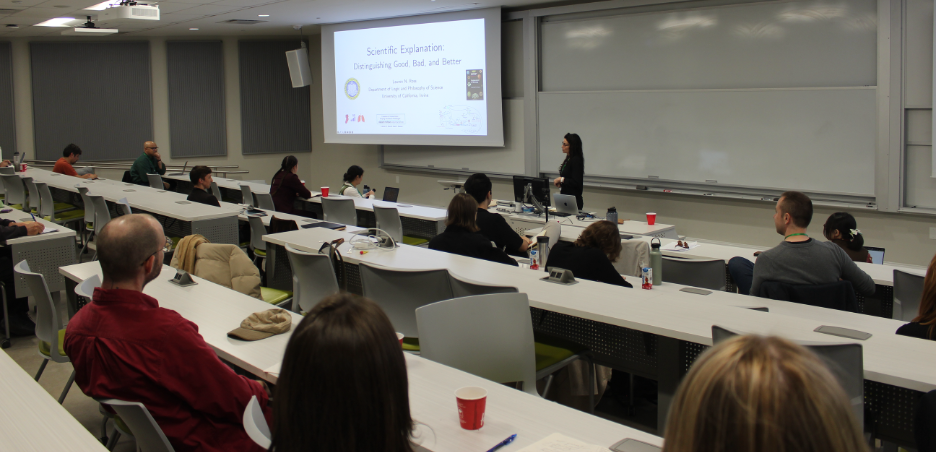
On May 3, 2026, Dr. Lauren Ross presented “Scientific Explanation: Distinguishing Good, Bad, and Better”. Her talk examined causal explanation in the life sciences with a focus on clarifying standards for causal explanation in these domains. Ross’s talk began from the premise that how good an explanation needs to be depended both on the researcher and on the explanation's purpose. From there, she offered an account of what distinguishes good, bad, and better causal explanations, using a control-element framework on which explanatory quality tracks how much information an explanation provides about control over its target.
The Rotman Graduate Student Conference 2026 showed philosophy and the life sciences at work together, each shaping the other’s questions and methods. Dr. Bassett’s and Dr. Ross’s keynotes demonstrated, from two different directions, how philosophical questions about explanation, causation, and the social structure of science are inseparable from the practice of science itself. Our big thanks to everyone who presented their work over the two days. Recordings of the keynote talks are available on the Rotman Institute’s YouTube channel.
This year also brought some well-deserved recognition. Two essay prizes were awarded: to Caitlin Mace of the University of Pittsburgh, for her paper “The Vehicle Indeterminacy Problem in Neuroscience,” and to Larissa Wilks of the University of Calgary, for her paper “Charges of Anthropomorphism in Debates about Biological Agency.” For the first time this year, the conference also hosted a poster session; the best poster prize was awarded to Ashar Khan for his poster, “Robustness Analysis as a Constraint, Not Confirmation: The Case of Obesity Modeling.”
The full range of work presented over the two days reflects the conference’s aim of putting philosophy into productive conversation with other disciplines, a conversation we look forward to continuing next year. Thank you to everyone who made this year’s conference possible.