
Search Website
Translating Knowledge, Creating Connections: Highlights from the Rotman Institute Research Retreat
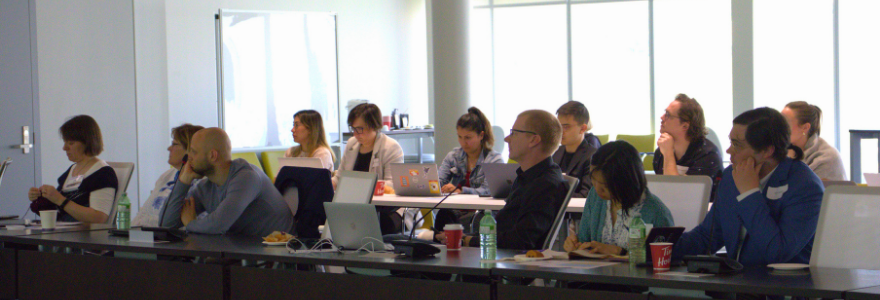
Paul Arnold
What happens when knowledge moves from one context to another? What is gained, changed, or lost in the process?
In May 2026, the Rotman Institute of Philosophy gathered over 60 researchers representing 7 faculties and over 20 departments and research centres at Western University to talk about the practice of knowledge translation—or, increasingly, knowledge mobilization—which is what happens to knowledge when it moves across disciplines, institutions, and societal contexts.
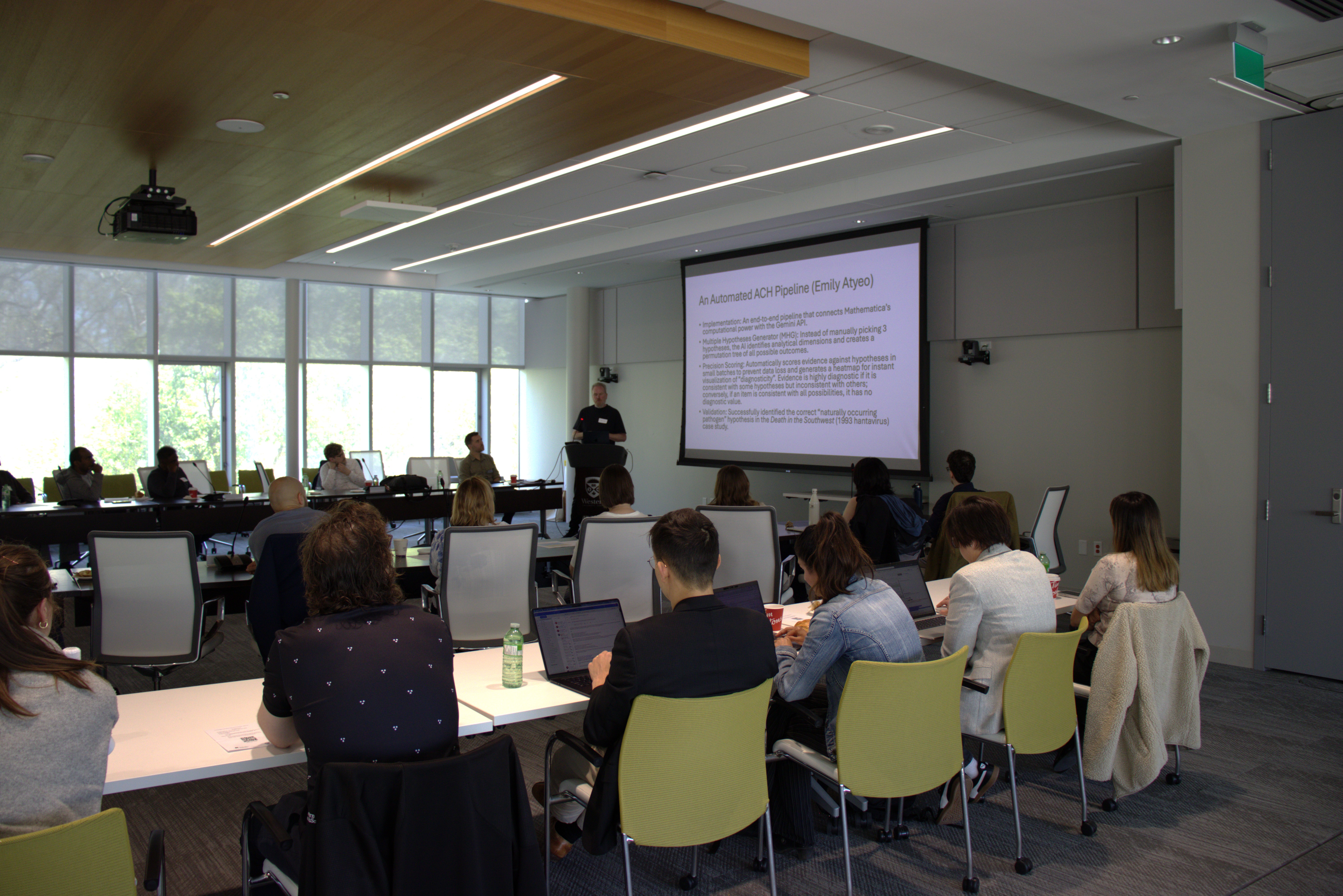
Traditionally, knowledge translation has been understood as the final step in a more-or-less linear and one-directional research process: first, identify the right questions to explore; second, design and conduct a study to interrogate those questions; and third, communicate the findings to a broader audience. In this view, the knowledge produced by research is disseminated in one direction: from experts to non-experts.
However, research rarely, if ever, proceeds so neatly. Sometimes a research project begins rather than ends with the questions and experiences of non-experts, such as patients in the medical system. Sometimes it begins with an unexpected result that was not anticipated. And sometimes it begins with a conversation between experts from different fields, where each is an expert in one area and a non-expert in another.
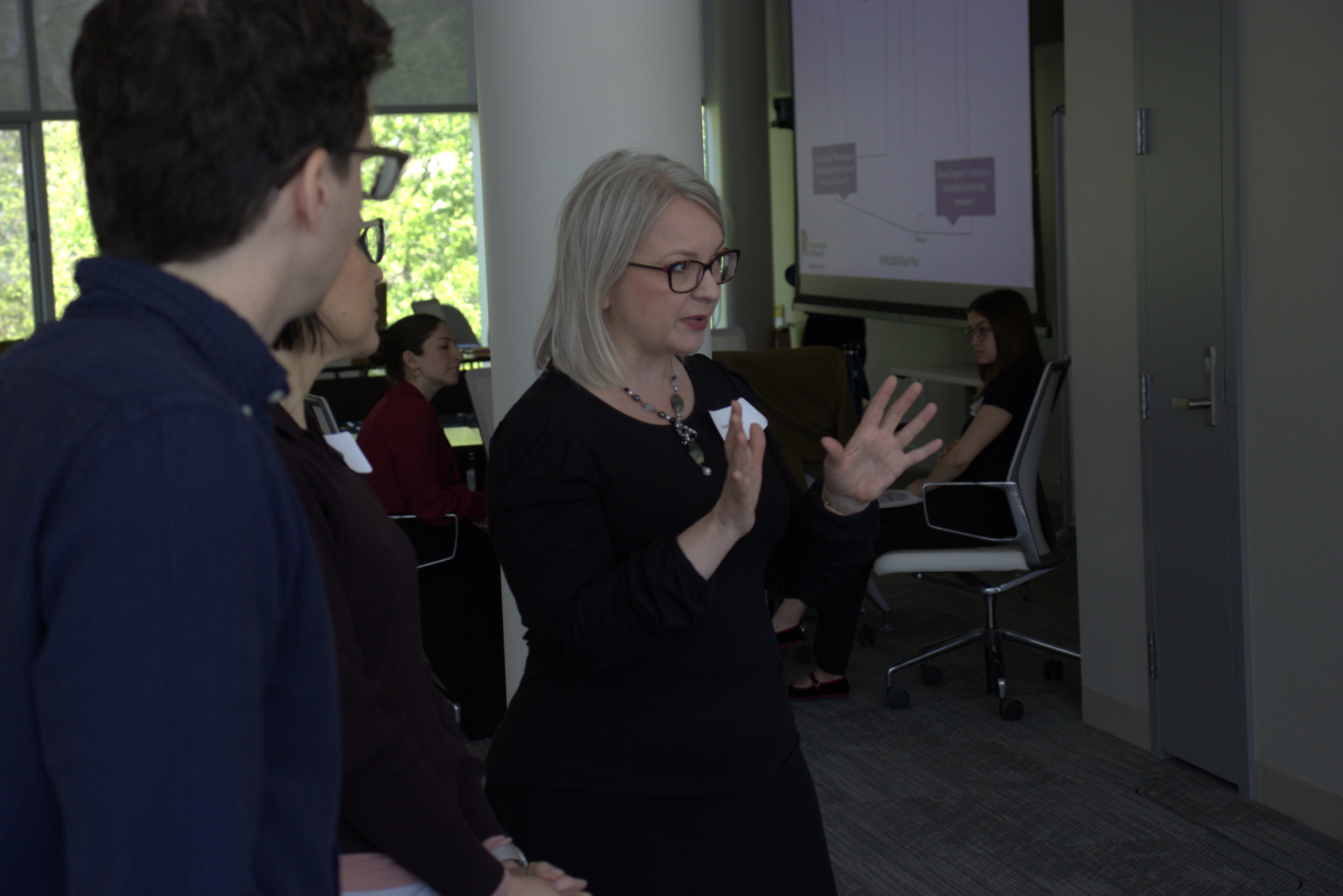
Small breakout groups explored various knowledge translation challenges, including translating for multiple audiences and the limitations of translating knowledge across contexts.
The research retreat brought together researchers interested in a more complex and collaborative understanding of the research process. The retreat explored how knowledge translation may be fundamental to research itself rather than merely a downstream output. The retreat consisted of a mix of short presentations and interactive activities aimed at offering various perspectives on a shared problem. Participants explored topics that ranged from knowledge co-production within interdisciplinary research teams, to the role of museum artefacts as catalysts for knowledge translation, to case studies on Canadian intimate partner violence, and to ethical approaches to urban encampments.
The participants raised a number of important questions: What happens when knowledge is translated or transported from one context to another? What is lost in the process of translation? What are the social and institutional conditions that enable successful knowledge translation to occur? How does social status effect the way that knowledge is created or received?
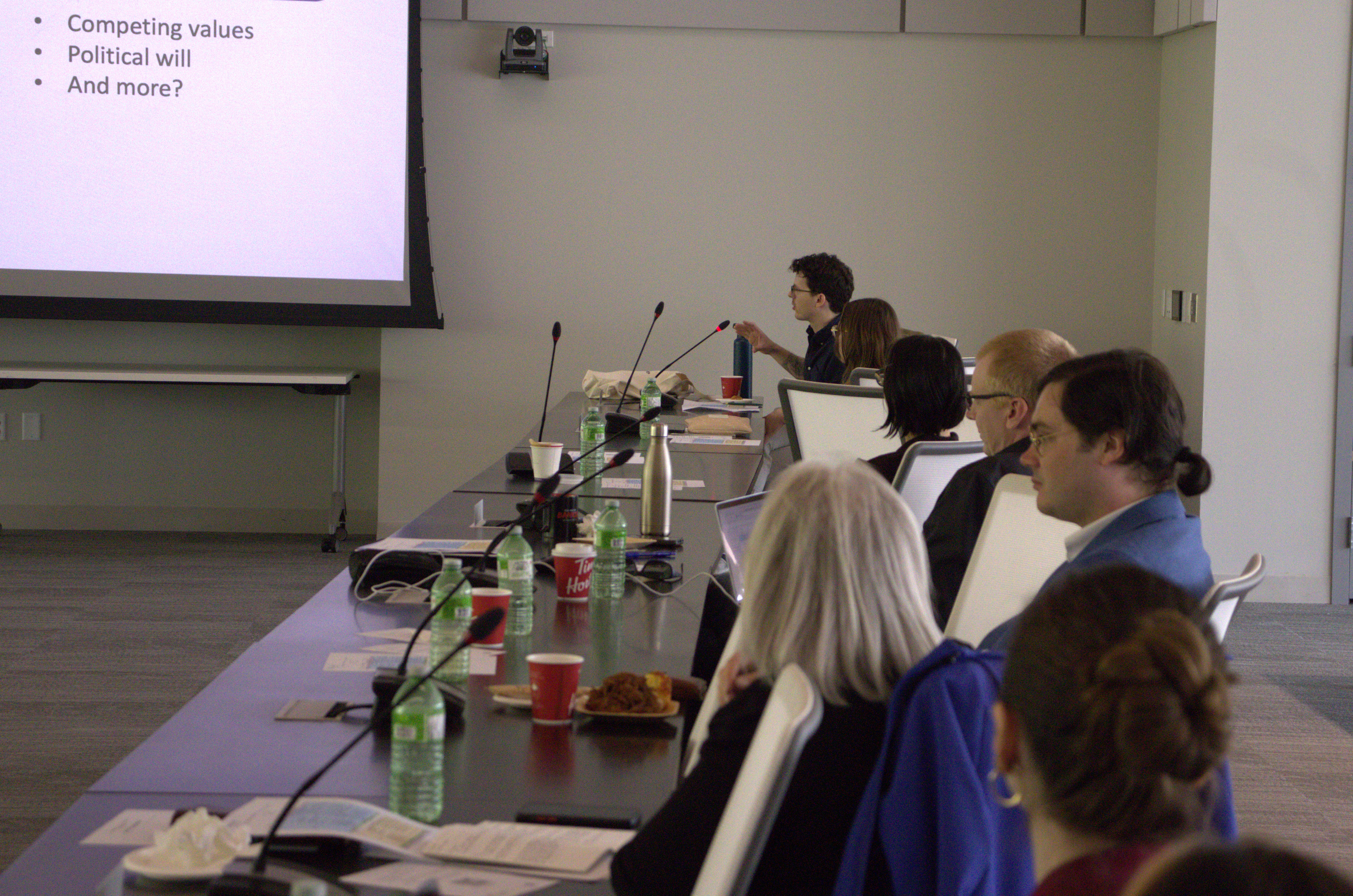
Researchers from across campus brought insightful questions to the Knowledge Translation Retreat.
A consistent thread throughout the day was the commonality of researchers’ experiences despite the diversity of topics and perspectives explored:
“I was struck by two seemingly contradictory observations that I think really encapsulated the day for me. I was amazed at the diversity of backgrounds, topics, and perspectives assembled in one room, but simultaneously by how much common ground everyone seemed to have when it came to discussing the benefits and challenges associated with knowledge translation.” - Richard Vagnino, Postdoctoral fellow at the Rotman Institute of Philosophy.
Jackie Sullivan, Associate Professor in the Department of Philosophy, highlighted the commonality of experiences amidst a diversity of perspectives present. In her presentation, titled “Coordinated Pluralism: A Framework for Thinking about the Ideal of Interdisciplinary Knowledge Co-Production and the Challenges of Realizing it in Practice,” Jackie highlighted the importance of “epistemic dependence” and the challenge of collaborating across disciplines. For Jackie, for a collaboration to be successful, each individual must be willing to acknowledge the limits of their own knowledge so that they can trust and learn from their collaborators:
“Because team members possess different but (commonly) complementary forms of expertise, successful collaboration depends not only on their ability to communicate effectively across disciplinary divides but also on their recognition of the limits of their own expertise, their respect for each other's expertise, and their willingness to trust collaborators' judgements in areas where they lack expertise. In other words, the effective translation of knowledge across disciplines not only involves successfully conveying what one knows (i.e., “know-that”), it also involves forms of tacit knowledge, e.g., “knowing how” (e.g., knowing how to successfully and productively navigate the boundaries of one’s own and another’s expertise). This leaves open the possibility that knowledge translation is a skill that may be developed and cultivated across one’s collaborative experiences.”
Discussions at the research retreat made it clear that knowledge translation is not just a specialized activity that occurs at the end of a research project. It occurs anytime researchers move between concepts, methods, forms of representation, disciplines, and audiences—that is, at any point in the research process. Drawing on his research on analogy, Vagnino explains:
As someone who studies analogy, and does so from an interdisciplinary perspective, knowledge translation is pretty central to almost every aspect of my work. Much of what I study involves how analogy can help individuals transfer knowledge between contexts, so knowledge transfer comes up quite often in the content of my research. But I also draw from the philosophical, historical, and cognitive science literatures, which not only requires translating and synthesizing insights from these different domains when doing analytical work, but also potentially translating my findings for often quite different audiences.
For Jack Kausch, a PhD graduate in the Faculty of Information and Media Studies, knowledge translation offers a way of understanding different systems of representation:
Knowledge translation is important to my work because translation provides a theory and practice to ground how knowledge can be represented in different knowledge organization systems (taxonomies, thesauri, glossaries and ontologies) and contexts (institutions, communities of practice, linguistic communities). Translation also provides a theory of meaning which transcends the merely linguistic, freely mediating between forms of knowledge in qualitative, quantitative and pragmatic domains.
Knowledge translation does not simply involve replacing technical language with more accessible terminology. It requires moving between different ways of organizing, representing, and interpreting knowledge—each of which may emphasize different features or serve different purposes.
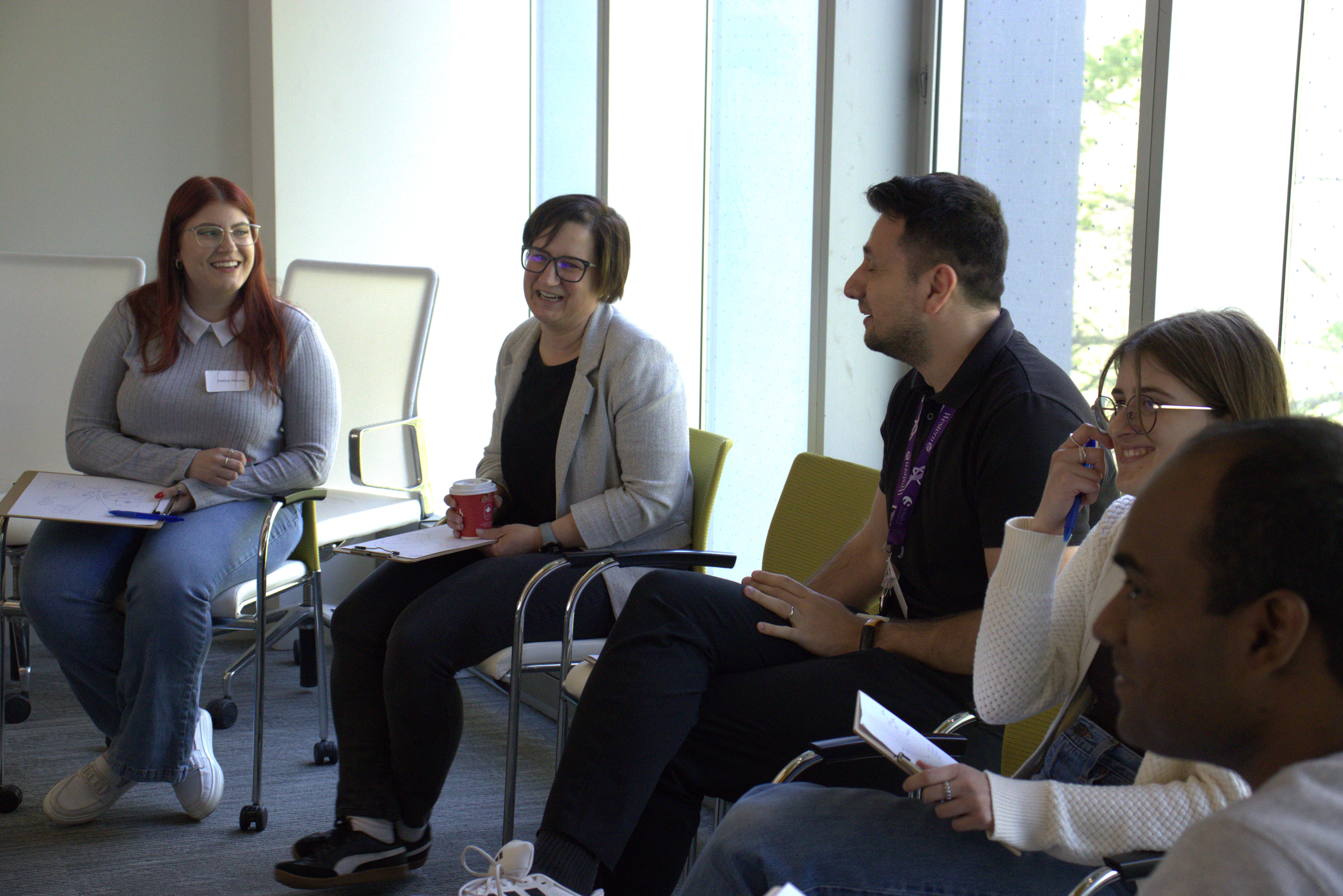
Researchers enjoyed many opportunities to collaborate and discuss ideas pertaining to Knowledge Co-Production throughout the day.
The Institute’s next step is to continue the conversation because conversations between experts in different disciplines are a central way that knowledge is translated, shared, and co-produced. To support these ongoing discussions, the Rotman Institute of Philosophy is establishing a Knowledge Translation Working Group where researchers can further examine how knowledge moves across disciplines and contexts, share case studies and works in progress, and develop new collaborations. To join the conversation, please contact Paul Arnold (parnold6@uwo.ca).