Search Website
2026 Rotman Graduate Student Conference
Theme: Philosophical Issues in the Life Sciences
The Rotman Institute of Philosophy is excited to announce the second annual Rotman Graduate Student Conference, taking place on Saturday, May 2 and Sunday, May 3, 2026. We are pleased to announce Philosopher, Dr. Lauren Ross (University of California, Irvine) and Professor of Bioengineering, Dr. Dani S. Bassett (University of Pennsylvania) as our keynote speakers.
This will be a hybrid conference with in-person (WIRB 1170) or virtual (Zoom) attendance options available. Attendance is free, but for planning purposes, advance registration is required and must be completed prior to April 20, 2026.
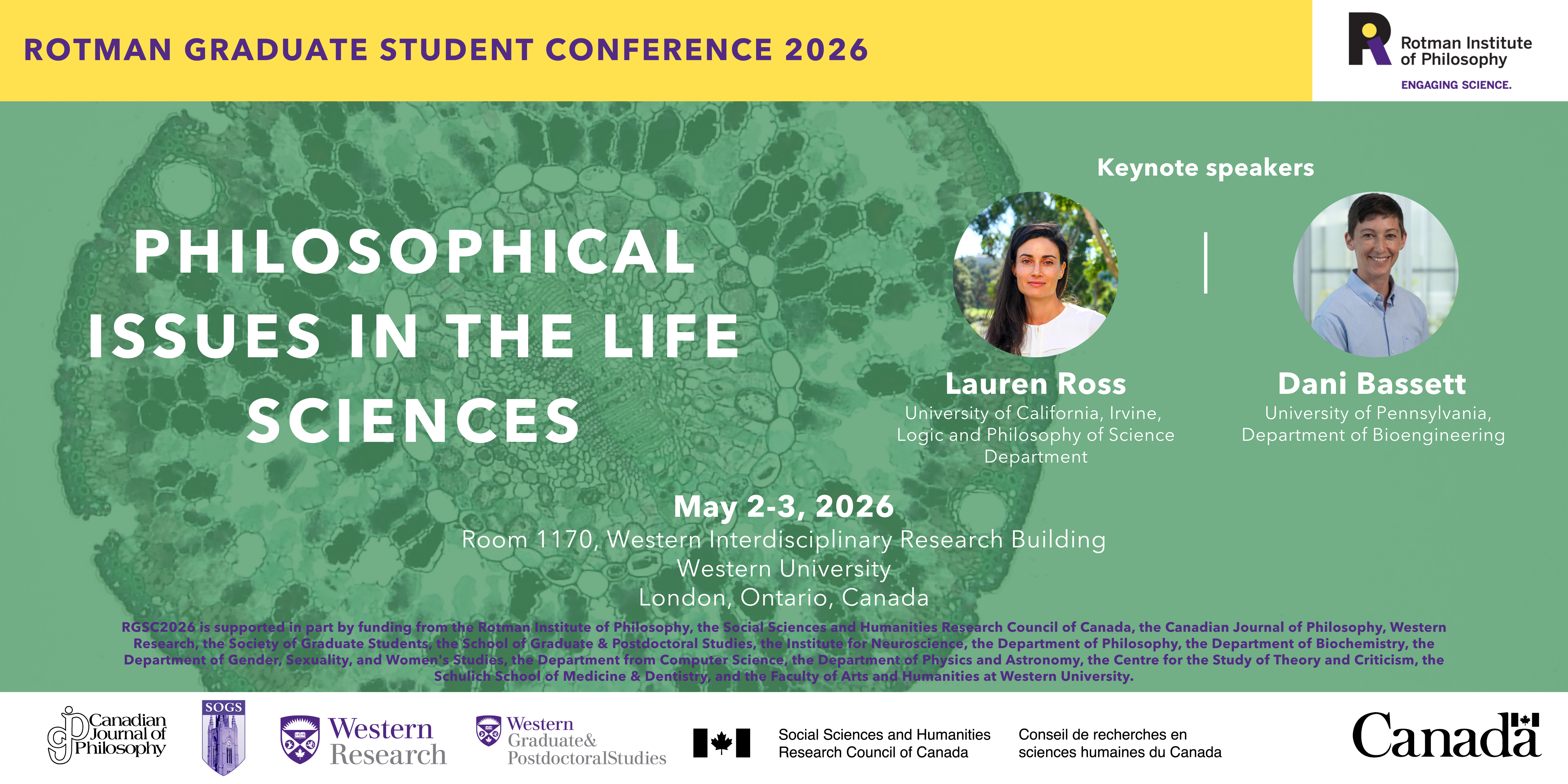
Lauren Ross, University of California, Irvine

Speaker Bio: Lauren Ross is a Dean’s Professor and Chancellor’s Fellow in the Department of Logic and Philosophy of Science at the University of California, Irvine. Her research focuses on explanation in the biological and biomedical sciences, with particular attention to causal reasoning, causal selection, causal constraints, and complexity in scientific practice.
Ross received her Ph.D. in History and Philosophy of Science from the University of Pittsburgh, her M.A. in Bioethics from Pitt’s Center for Bioethics and Health Law, and her M.D. from the University of California, Irvine. She is the author of Explanation in Biology (Cambridge University Press), which develops a systematic account of explanatory patterns in the life sciences and examines how biologists justify causal claims. Her work has appeared in leading journals, including Philosophy of Science, The British Journal for the Philosophy of Science, and Synthese. Her collaborative article with co-keynote speaker Dani S. Bassett, “Causation in Neuroscience: Keeping Mechanism Meaningful,” appeared in Nature Reviews Neuroscience.
Title: Scientific Explanation: Distinguishing Good, Bad, and Better
This talk examines causal explanation in the life sciences---primarily biology and neuroscience---with a focus on clarifying standards for causal explanation in these domains. Specifying standards for scientific explanation is important for many reasons. These include the fact that such standards (i) guide decisions about which research is funded and published, (ii) they allow us to justify why science provides our best understanding of the world (in contrast to horoscopes, reading tea leaves, and mere guesses), and (iii) they support successful science communication to expert, public, and other audiences. This talk provides an analysis of standards that distinguish causal explanations that are good, bad, and better. More specifically, these standards distinguish (a) explanations from non-explanations, and (b) explanations that differ in terms of their quality, “explanatoriness,” or “explanatory power.” I suggest that these standards can be captured with a control element account, on which causal explanations appeal to factors that provide information about control over the explanatory target. I introduce this account, show how it achieves the goals outlined above, and discuss how it differs from alternative accounts in the literature.
Dani Smith Bassett, University of Pennsylvania
 Speaker Bio: Dani S. Bassett is the J. Peter Skirkanich Professor at the University of Pennsylvania, with appointments in Bioengineering, Electrical and Systems Engineering, Physics and Astronomy, Neurology, and Psychiatry, and is also an External Professor at the Santa Fe Institute. Their research integrates neural and systems engineering to study the structure and function of brain networks, with a focus on cognition, learning, and mechanisms of neurological and psychiatric disease.
Bassett received their B.S. in Physics from Penn State University and their Ph.D. in Physics from the University of Cambridge as a Churchill Scholar and NIH Health Sciences Scholar. Bassett is the author of more than 300 peer-reviewed publications. Their trade book Curious Minds: The Power of Connection (MIT Press), co-authored with Perry Zurn, explores how curiosity builds networks of ideas and relationships by tracing its diverse styles and cognitive patterns.
Title: The Humanity of Science
The progress of science is made possible by the exchange of information between people, whether informally over a cup of coffee or formally through peer-reviewed publications. In the formal exchange occurring in scholarly articles, we use references to buttress our communication: we cite the work of other scholars to build our arguments, contextualize our results, and foreground possibilities for future research. Despite being a critical feature of science communication—as well as a history of ideas—little remains known about how scientists choose references and how those choices influence the exchange of information that subtends advancement in the field. Here I will examine citation practices—who we cite and how favorably or critically we cite them—in several disciplines from 1995 to today using extensive bibliometric analysis and capitalizing on recent advances in large language models. In describing the results of 3 separate studies, I will demonstrate that citation practices differ by author gender, vary with journal prestige, and track social norms of small groups, larger disciplines, and whole countries. Collectively, the results demonstrate that science is social, and scientific practices are bound by the complexities of human behavior. This fundamental humanity of science raises important questions about social justice and inequalities of privilege that have critical import for educating the next generation of young scientists.
The theme of this year’s conference is “Philosophical Issues in the Life Sciences”, and will focus on the conceptual, epistemological, and metaphysical issues arising in biology, neuroscience, psychology, and related fields. We encourage graduate students to submit original papers or poster ideas that address important problems or are motivated by questions concerning the life sciences, broadly construed.
Submissions are accepted through the following form: Submission Form (link)
We invite submissions for both papers and posters addressing the conference theme.
Papers:
- Maximum length of 5,000 words, including footnotes and appendices (but excluding references).
- If the paper includes tables, figures, or equations, an appropriate number of words should be subtracted from the limit.
- Each paper should be accompanied by an abstract of no more than 300 words.
- Papers must be prepared for anonymous review (i.e., the author’s name and identifying information should not appear in the file).
Posters:
- Abstracts of no more than 300 words.
- Poster submissions should also be prepared for anonymous review.
Examples of topics may include but are not limited to:
- Causation and causal inference in the life sciences
- Modeling, explanation, and understanding in neuroscience, biology, and ecology.
- The conceptual and methodological role of simulations in research practice
- Biases in conservation and their ethical, social, and epistemic implications
- The impact of genetic enhancement on autonomy
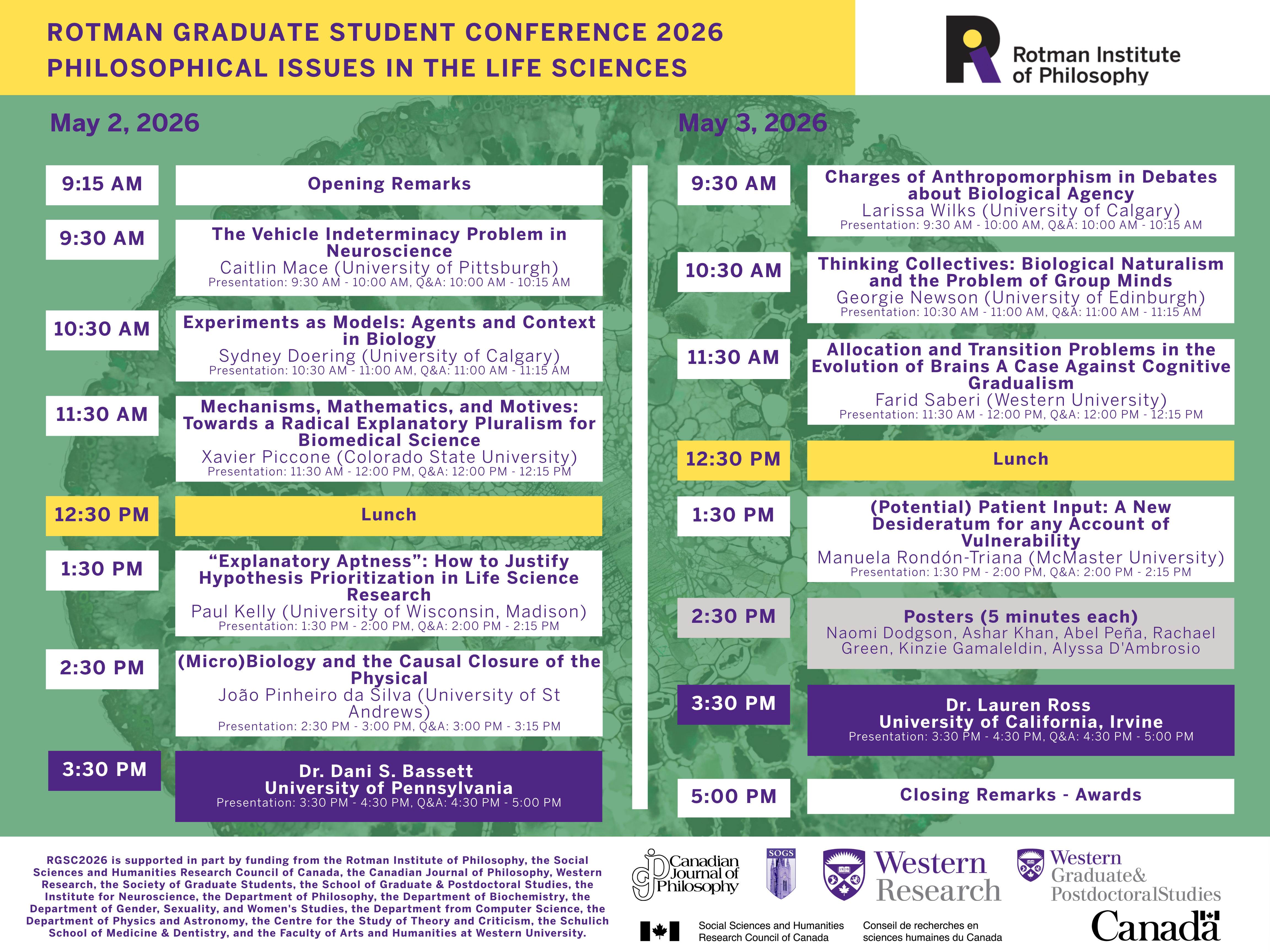
Authors of accepted papers will be allocated for a 45-minute session, consisting of approximately 30 minutes for presentation followed by 15 minutes for discussion.
Authors of accepted posters are expected to design and print their posters in advance and display them during the conference at designated poster sessions.
Please send any questions to the RGSC2026 Committee: rgsc@uwo.ca
Support for RGSC2026 has been provided in part by the Rotman Institute of Philosophy, the Western Institute for Neuroscience, Schulich School of Medicine & Dentistry and the Faculty of Arts and Humanities at Western University, Western Research, the Society of Graduate Students, and the School of Graduate & Postdoctoral Studies, and additional generous support from the following departments at Western University: